
The practice of police remand in Bangladesh frequently results in custodial torture and cruel, inhuman treatment to extract confessional statements from the suspect. This raises serious concerns about the voluntariness of the statements given as the admissibility of confessional statements primarily lies in the voluntariness. Section 61 of the Code of Criminal Procedure, 1898 stipulates that an individual arrested in connection with a case must be forwarded before a magistrate within 24 hours. When investigation cannot be completed within this timeframe, section 167 permits a magistrate to authorize either judicial or police custody for a period not exceeding 15 days. However, this discretion is not absolute as the magistrate is required to record reasons for authorizing detention of the accused in the custody of the police. Human rights advocates argue that the legal framework for police remand enables systemic custodial violence. The focal point of human rights concern lies in the authorization of police remand which is often perceived as a method of extracting confessions through coercion, intimidation and physical or mental torture.
In fact, a vicious cycle has emerged which shows that the authorization of police remand by the magistrate is the initial step to secure a confessional statement from the suspect and turn a perfunctory investigation into a successful conviction case. The vicious cycle involves the following five propensities: police arrest a suspect and take him under custody for interrogation; the suspect is forwarded to the Magistrate as section 61 obliges police to do so and police needs more time with the suspect for interrogation in return; magistrate grants police remand; suspect faces intimidation and life threats to admit guilt and custodial torture ensues; the suspect agrees to give a confessional statement to avoid torture; the magistrate records the confessional statement right after police remand; and the confessional statement becomes the sole basis of conviction. Wealthy accused often succeed in avoiding police remand and custodial torture either by bribery or securing judicial relief, such as jail-gate interrogation. This practice highlights a structural inequality wherein the criminal legal system disproportionately disadvantages the socioeconomically marginalized section.
The Constitution of Bangladesh guarantees fundamental rights to individuals under arrest. Article 33(1) mandates that an arrestee must be promptly informed of the reasons for their detention and be allowed access to legal counsel. Article 35(4) protects individuals from being compelled to testify against themselves. Nevertheless, section 167 of the CrPC authorizes the magistrate to remand suspects to police custody if they believe it may yield further information, a provision that appears to be in contradiction with the constitutional guarantees afforded under Articles 33 and 35. Therefore, it is humbly submitted that the police remand is unconstitutional. In police remand, police torture and threaten the accused to spill information regarding a theory developed and believed by the police. If the accused decides not to open his mouth in front of the police, then what happens? More remands are being authorized by the magistrate. It can be reasonable claimed that our criminal legal system is prone to force a citizen to admit his guilt before trial as the prosecution fails miserably to produce evidence and prove a case on merit.
Sections 25 and 26 of the Evidence Act also invalidate any confession made to a police officer or in police custody. Suppose the relevant section of the Evidence Act is read in conjunction with the articles of the Constitution. In that case, it manifests that the spirit of the law is against the prevalent practice of recording confessional statements immediately after police remand. There must be a cooling period for 2-3 days when the suspect will be completely out of police custody before any confession is recorded, recommends the UN Special Rapporteur on Torture. Hence, Indian courts have developed a practice where a magistrate sends the accused to jail custody for reflecting his decision after being produced by the police for giving a confessional statement. Despite the legal requirement that confessions must be made voluntarily, it is highly questionable how voluntariness can be ensured in the context of remand where coercive interrogation techniques are routinely employed. Logically, if a confession is given following a period of torture, it is unlikely to be a product of genuine remorse and more likely a result of coercion. Therefore, confessions made immediately following police remand should not be treated as admissible evidence. The continued recognition of such confessions within the criminal legal system underscores the vulnerability of citizens subjected to existing procedures. Our legal system does not recognize plea bargaining and mitigating sentences for the accused who confess. It is insane to think that someone would volunteer to give a confessional statement only to be sentenced to death. No one gives a confessional statement, rather, the suspect is produced against his will before a magistrate in handcuffs after days of enduring torture in police remand. A notable case from 2020 illustrates this issue. In Narayanganj, police coerced three individuals into confessing to the rape and murder of a girl. However, 54 days later, the supposed victim returned home unharmed, rendering the confessions completely baseless and exposing the grave dangers of relying on the allegedly voluntary confessional statement recorded by the magistrate. The voluntariness of the confessional statement is imposed as it is recorded by the magistrate, not that it is free from inducement, threat or custodial torture in police remand. In the landmark BLAST vs. Bangladesh (55 DLR 363), where a university student, Shamim Reza Rubel, died in police custody after being subjected to severe torture by the Detective Branch. Rubel had been coerced into confessing possession of illegal arms— none of which were ever recovered. the High Court Division issued 15 directives aimed at reforming arrest and remand procedures. Key directives include: interrogations must be conducted within a transparent glass walled room located inside the prison. A magistrate’s permission is required before any custodial interrogation can take place. The detainee must undergo medical examinations before and after interrogation. If allegations of torture are made, a medical board must be constituted to verify the claims and disciplinary action must be taken against those responsible if proven. Despite these directives, the legislature did not amend existing remand provisions of the Code of Criminal Procedure.
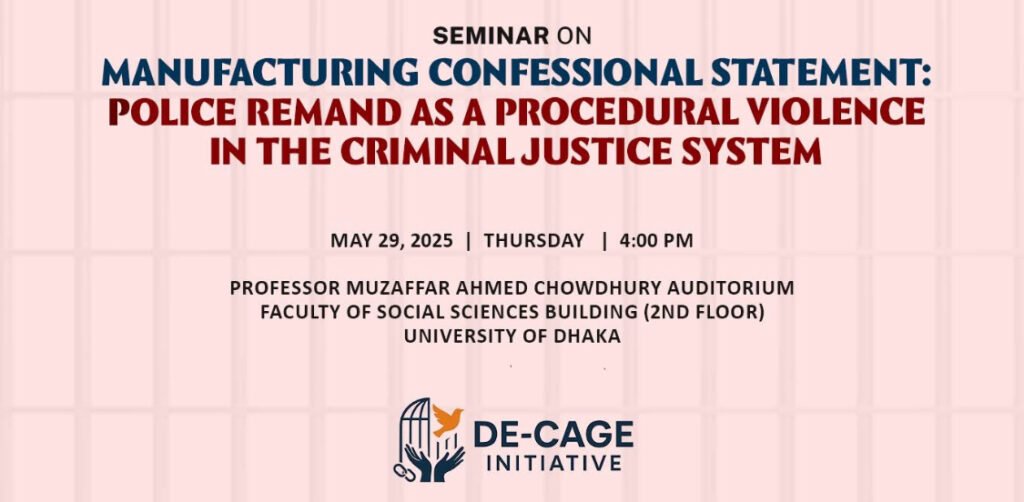
De-Cage Initiative arranged a seminar titled “Manufacturing Confessional Statement: Police Remand as a Procedural Violence in the Criminal Legal System of Bangladesh” at the Muzaffar Ahmed Chowdhury Auditorium of the University of Dhaka on May 29, 2025, at 4 pm. In the seminar, the keynote speaker, Dr. Md. Mahbubur Rahman, a criminal law expert and professor at the Department of Law, University of Dhaka, said that extracting confessions through police remand is a form of ‘systemic violence’. By law, the accused cannot be compelled to testify against himself and under no circumstances is torture permissible in the name of interrogation. There is no scope for deviation from this legal standard—it is an absolute fundamental right. However, due to discrepancies between constitutional provisions and practical realities, the majority of Bangladeshis believe that remand is synonymous with police torture. Law Enforcement Agencies and government officials often deny allegations of torture in police remand. In this regard, Magistrates and government narratives often align.
When a magistrate certifies a confession as voluntary, the court assumes it to be true. At that point, it becomes the burden of the accused to prove that the confession is false. “Why or when would an accused voluntarily confess, knowing they will be punished unkindly?” This may happen for only two reasons: guilt or the hope of reduced punishment. In many other countries, early confession can lead to sentence mitigation. However, no such legal framework exists in Bangladesh.
Apparently, no one’s conscience awakens unless they’re in police custody. it is always those in custody who confess. Those in jail or fugitives do not. So why do people “realize their guilt” only when in police custody? The answer is very simple and well known. Custodial torture. Almost every confession is extracted through torture. It is the magistrate’s duty to ensure this does not happen. Government officials often deny these issues as a self-protective strategy. Even the judiciary knows that the entire process is a “systematic denial of violence.” Therefore, the responsibility for custodial torture lies more with the judiciary than with the police. In many countries, the conviction rate is over 90%. In Bangladesh, the actual conviction rate is around 10%. Efforts are often made to manufacture convictions through securing confessional statement which is the consequent of remand torture, in an attempt to raise this number. Simply walking on the streets here can feel risky.
‘Piecemeal reform’ won’t work—it might even be counterproductive. For example, after the 2003 BLAST case verdict, it was thought that police torture would stop, but it didn’t. Even after the 2013 law to prevent torture and deaths in custody, there are concerns and patters that show that forced disappearances may have increased due to this law. His hypothesis suggests they have. One proposal from the De-Cage was to introduce a mandatory “cooling-off period” before any confession is taken. He supported this as a good idea. He emphasized the need for comprehensive reform—just enacting laws or creating agencies won’t suffice. Good governance and an independent judiciary are essential. Only then can we have a violence-free jurisprudence and political discourse. These steps, even without new laws, can resolve many issues.
At the seminar, Additional Chief Metropolitan Magistrate of the Chief Metropolitan Magistrate’s (CMM) Court in Dhaka, Md. Zakir Hossain, said that excessive workload is a major obstacle to justice. For instance, there are only 37 magistrates for 52 police stations in Dhaka. With such limited manpower, it is not possible for them to dedicate enough time to each case. In addition, political lobbying and pressure, along with weak prosecution, are significant hindrances to justice. Moreover, forensic investigation in the country faces serious limitations and is largely ineffective.
Zia Uddin Ahmed, Metropolitan Magistrate of the Dhaka CMM Court, remarked that police psychology is such that they feel successful only when they extract a confessional statement. Section 164 is not the Bible. Its importance should be reduced. Other speakers at the seminar included senior Supreme Court lawyer Helal Uddin Molla, human rights activist Mushfiq Johan, lawyer Zahirul Islam Musa, and Anwar Shankar, who became a victim of custodial torture in 2005.
However, there are a number of international practices and models that Bangladesh could adopt to curb custodial torture. In the United States, the Miranda Rights established through Miranda v. Arizona (1966) require police to inform arrestees of their right to remain silent and to access legal counsel during arrest. Similarly, in the Netherlands and Tunisia, legal provisions now guarantee the presence of a lawyer during police interrogation. In France, newly updated laws require that no police questioning can proceed without legal counsel, and if a lawyer is unavailable, the state is obligated to appoint one. The European Union has introduced the “Letter of Rights,” which ensures that detainees are informed of their legal entitlements— including the right to silence, access to legal representation, and the maximum duration of custody—in clear, accessible language upon arrest. The remand regime must ultimately be abolished. However, as long as a confessional statement immediately after police remand is considered as evidence, the abolition of remand is not possible, simply because remand and confession enable each other. It would be more legal and trustworthy if confessional statements were taken after the accused had spent their reflection period in jail custody. Admissions of guilt produced under duress and torture rarely reflect the accused’s true culpability, but rather the will of the interrogators. As such, any confession obtained under these conditions is deemed involuntary and hence inadmissible in a court of law. Several countries have introduced robust mechanisms to prevent custodial abuse and ensure the voluntariness of confessional statements. For instance, Croatia, Romania, Ireland, and Portugal requires audio-visual recording of all police interrogations. The United States, Australia, the Netherlands, South Korea, and various EU member states permit or mandate the presence of legal counsel during interrogations and confession recordings. The United Kingdom, through the Police and Criminal Evidence Act (PACE) 1984, ensures video-recorded interviews, legal representation, and mechanisms to confirm the voluntariness of statements. In the United States, there has been a notable expansion of the use of body cameras and custodial video surveillance to document the full process from arrest to confession. These practices offer an ideal picture of how police interrogation should be, and can be adopted by the police force of Bangladesh to eradicate the systemic custodial violence. Police reform has been widely acknowledged as one of our national priorities after the mass uprising of July, 2024. The Police Reform Commission also recommended several initiatives to curb police violence. In light of those recommendations and the aforementioned international practices, immediate reform should be brought in the overall police remand, interrogation and confession-recording process.