
On 26 August 2025, IG Prisons announced that the Government had decided to rename the Department of Prisons to Correction Services Bangladesh. This move came with a list of ‘reforms’ and drafting of a new piece of legislation, the Correction Services Act 2025. But this begs an important question: Is it merely a rebranding, or does it signify a genuine change in how the country views sentencing and punishment? This development raises a deeper question: will Bangladesh finally break from its colonial legacy, or is this merely a cosmetic exercise? What recent developments have emerged, how have other countries dealt with such changes, and what barriers still hinder genuine transformation?” The fact is that the mere name change has some symbolic and political value, but whether it will result in real structural change depends on the political will of the relevant authorities.
Rooted in the 1894 Prisons Act, Bangladesh inherited a system designed for control, not rehabilitation. With the backing of these laws, prisons were built to snuff out opposition and incarcerate nationalist leaders. Conditions were harsh, with emphasis entirely on discipline and order. Post-independence period did not witness any change in the administrative system of these institutions. Overcrowding, poor medical care, and delays in the trials of inmates became hallmark features of jails. In the Pakistan era, prisons were overcrowded, mismanaged, and politically manipulated. Political leaders were also confined frequently. Cases like the Agartala Conspiracy Case saw prisons emerging as tools of political repression. The same colonial structure was bequeathed to Bangladesh at its independence in 1971. A legacy that persists despite independence and minor legislative pinches.
As of August 2025, the official number of total prisoners is 78,001, whereas the authorized capacity is 43,000. Hence, the overcrowding rate in prisons is above 180% with approximately 74,870 men and around 3,131 women in prisons. Moreover, the number of children who live with their convicted mothers is reported to be 200+. More than 75 percent of inmates are under-trial prisoners awaiting judgment. A shortage of judges, bureaucratic backlogs, and insignificant legal assistance exacerbate this crisis. In addition, the health care is far from satisfactory, with one doctor for every 1000 prisoners, while mental health services are de facto nonexistent.
We can see that the government has recently adopted a reformist approach under the Correction Service Act 2025, reminiscent of the UN Mandela Rules. The act focuses on rehabilitation, skill development, and social reintegration. With 1,899 employees and 1,500 new additional posts demanded, the government also listed a series of changes which included the proposal of constructing 2 more Central Jails and 4 District Jails, fiber-optic cables linked prisons, artificial intelligence integrated CCTV, bodycam, mobile phone jammers, scanners and digital attendance incorporated prison system, digitalized visits to inmates and calls with a hotline number, better meals and sports, cultural programs, counselling, fitness arrangements for inmates. Additionally, a correctional industrial park to ensure productive employment of the prisoners was announced. Prisons are planned to be accessible, fair, transparent, and open to independent review groups (IRGs). Such groups can involve civil society organizations (CSOs), volunteers, and nongovernmental organizations (NGOs) that operate independently from the government. These organizations will therefore be able to monitor prison conditions, report problems, and advocate for policy changes.
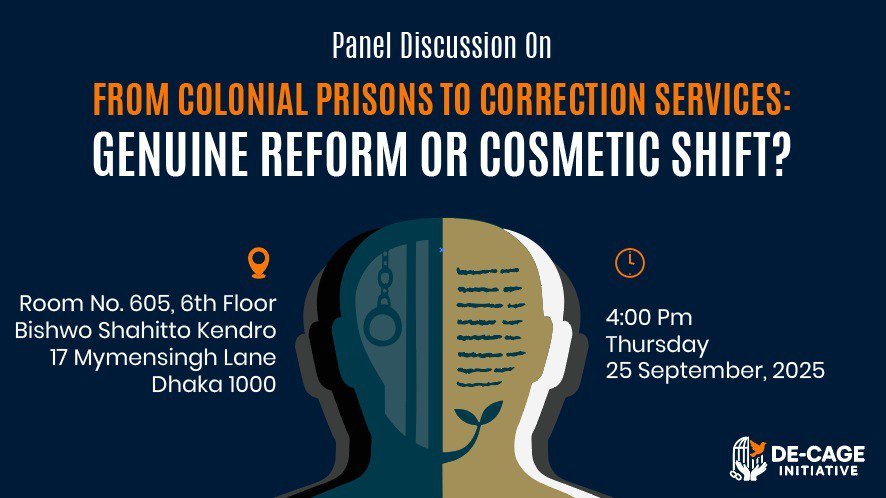
A panel discussion titled ‘From Colonial Prisons to Correction Services: Genuine Reform or Cosmetic Shift?’ was held by Decage Initiative at the Bishwo Shahitto Kendro on September 25, 2025. The panelists present in the discussion were Brigadier General Syed Md. Motaher Hossain, Inspector General of Bangladesh Prisons; Deputy Attorney General Md. Ershadul Bari Khandaker; Colonel Mohammad Mustafa Kamal, Additional Inspector General of Bangladesh Prisons; Dr. Sazzad Siddiqui, Associate Professor and Chairman, Department of Peace and Conflict Studies, University of Dhaka; Dr. Tawohidul Haque, Associate Professor, Institute of Social Welfare and Research, University of Dhaka; Supreme Court Lawyer Jyotirmoy Barua; Mohammad Shahjahan Qureshi, Research Advisor, GIZ Bangladesh; Sabiha Mehzabin Oishi, Fellow, University of Oxford; Zia Chowdhury, Staff Correspondent, The Business Standard. The moderator of the discussion was Supreme Court lawyer Md. Zahirul Islam Musa. In a lively atmosphere, the panelists gave their valuable opinions on the need and rationale for changing the name of Bangladesh prisons to Correction Services.
In the discussion, the Inspector General of Bangladesh Prisons said that if the fundamental problems of the prisons are not resolved, the existing problems will continue to recur. As a result, changing the name of the prison is not a mere cosmetic issue, but rather a significant initiative to transform the punishment-based prison system into a rehabilitation-based prison system. From this perspective, an initiative is being carried out to modernize and humanize the current prison system by amending the existing law and replacing it with the Correction Services Ordinance which accommodates international documents like the Mandela Rules and Bangkok Rules. In response to a question from a panelist, he said that the probation or parole system is not working in Bangladesh mainly due to political abuses. In response to another question, he said that they are trying to convert the prison into a cashless institution to prevent the commercialization of prison services. He also commented that it is easy to corrupt prison employees because their salaries are low. While answering some questions about the health care of prison inmates, he said that they are planning to build a central prison hospital to provide proper health care to the prisoners. Referring to the acute shortage of manpower in the prison system, he said that currently there are no doctors and nurses in the prisons of Bangladesh. For example, he said that there is a lot of medical equipment in Kashimpur Prison but due to the lack of doctors, they have not been opened in the last eight years.
Additional Inspector General of Bangladesh Prisons Colonel Mohammad Mustafa Kamal said that prison reform initiatives are currently carried out keeping in mind three groups of people. Namely, prisoners, prison employees and families of prisoners and employees. He emphasized on solving the housing problem of the prison. While referring to the food problem, he said that earlier there was a provision of 36 grams of non-vegetarian food per day for prisoners, they have increased it to 54 grams. He also said that to overcome the manpower crisis in the prison system, permission has been given to hire 1899 people and employees in five years and 800 people have already been hired. He also said with regret that in an ideal prison system, there should be one prison employee for every three prisoners (1:3) but in Bangladesh, there is one employee for every nine prisoners (1:9). At present there is a shortage of 141 doctors in Bangladesh’s prisons. In response to a question at the end of the discussion, he said that in other countries, Department of prisons work under the judiciary but in Bangladesh, prisons are working under the Ministry of Home Affairs. He mentioned that this is also an obstacle in the path of prison reform.
Development Researcher Mohammad Shahjahan Qureshi said that the work of introducing a rehabilitation-based prison system should be started by conducting proper risk assessment and need assessment. He said that the draft of the new law has been prepared by forming an inter-ministerial committee. However, he thinks that permanent reforms will come in stages. It is not possible to change Bangladesh’s prisons overnight adding that not only prisons but also Bangladeshi society is responsible for recidivism. In response to a panelist’s suggestion about solving problems through privatization of the prison system, Mr. Qureshi reminds us that about one percent of the total population of the United States lives in prisons. He expressed concern that if prisons are privatized in Bangladesh, the demand and supply of prisoners will increase to keep private prisons running.
Deputy Attorney General Mohammad Ershadul Bari said that there is a need for a psychological change in the people regarding prisons. In the current judicial system of Bangladesh, no one remembers the human dignity of the accused, in which case the Correction Services Act can act as a light of dawn in the darkness. However, he said that the judiciary is mainly responsible for the overcrowding of prisons. Therefore, there is a need for coordination-based activities between the prison authorities and the judiciary.
Advocate Jyotirmoy Barua said that there are many inhumane rules and practices in the judicial system of Bangladesh. He commented that the irregularities and discrimination in the prison system are a manifestation of the larger discrimination. He branded the division system in prisons discriminatory. He also emphasized on creating a database of prisoners and digitizing it. At the end of the discussion, he said that many prisons are being closed in many countries of the world due to lack of prisoners. However, initiatives are being taken to increase the number of prisons in Bangladesh and there is a lot of talk about building the largest prison in South Asia. He raised the question of how appropriate this is or whether it is appropriate at all.
Associate Professor Dr. Sazzad Siddiqui said that political consensus is needed for permanent changes in the prison system. He commented that no isolated initiative will be successful. He said that the ‘tendency to copy’ or isomorphic mimicry will not be very fruitful. He quoted the concept note of the panel discussion and stressed that real structural change depends on the political will of the relevant authorities.
Professor Dr. Tawohidul Haque said in his discussion that there is no such system in action to control recidivism in our country. However, he warned that copying ideas from other countries would only increase the problems in Bangladesh stressing the need to find ‘indigenous solutions’ to Bangladesh’s prison problems. He also said that there is a need for psychological first aid for released prisoners and the inmates who have just entered prison. He stressed the need to change the social prejudices about prisons for permanent prison reforms. He also expressed interest in whether conditional imprisonment can be introduced in Bangladesh considering the situation like in other countries.
Academic Sabiha Mehjabin Oishee said that the biggest problem in Bangladesh’s prisons is overcrowding. Since this problem has not been solved so far even though it works under the government, she suggested moving towards an alternative system. In this case, she commented that privatization of prisons could be a solution. She also said that private prisons could be opened for relatively non-violent criminals, even if not completely.
Journalist Zia Chowdhury entered the discussion criticizing media observing that many unnecessary issues get attention of the media, however, prison related issues never get any spotlight. There is a negative tendency in public mind regarding prison and prisoners. He said that the situation is the same in the South Asia. Terming the criminal justice system of Bangladesh as a ‘fraud’ apparatus, he said that fundamental changes are needed not only in prisons but also in the entire criminal legal system.
There are several international standards that can be adopted in Bangladesh. In the UK, Independent Monitoring Boards provide trained volunteers who can go inside prisons unannounced and publish public reports. The Ombudsman in New Zealand is the official monitoring body under the UN’s anti-torture protocol. On the other hand, Norway’s Parliamentary Ombudsman collaborates with academic scholars and non-governmental organizations to conduct visits to prisons and disseminate reports produced on prison conditions to the public. It has been reported that the prison oversight system is weaker in Southeast Asia. However, some civil society groups have been fighting tooth and nail to make it better. NGOs have reported overcrowding and abuse in prisons in Malaysia and Indonesia despite government restrictions. In contrast, prison oversight has not gone well in Bangladesh. Civil society and non-governmental organizations are usually kept at bay. Torture, overcrowding, and death are reported but not investigated adequately. That is to say, “When independent monitors can be on the ground, they make places safer and more humane.”
The Correction Services Act 2025 is a tremendous opportunity for Bangladesh to bring structural change to the prison system. Probation, parole, circle sentencing, and open prisons for nonviolent offenders can be incorporated to reduce overcrowding. The annual budget of each inmate needs to be increased as well. Today, Bangladesh spends less than $1,000 per person annually, which needs to be increased to $3,000 by 2030. Furthermore, the authority has to facilitate appropriate vocational and skill-based training to inmates that will increase their employability prospects. At least 70 percent of inmates need to receive skill-building training before release. Additionally, Prison administration needs to improve healthcare by appointing one doctor per 300 inmates and integrating mental health support programs. Finally, independent review panels, NGOs, universities, and community organizers need to be integrated into the reformation procedure.
These changes could facilitate the transformation of prisons into real correctional centers. But some problems remain despite all these suggested reforms. The ex-inmates in our country still encounter job and housing bias. Secondly, rehabilitation is something most officers are not trained in. NGOs and civil society are not engaged in prison reform initiatives on a large scale. There are still plenty of people in this country from all walks of life who prefer punishment to reform. These are issues that are not to be taken lightly if we want a tangible transformation of the overall system. While changing the name conveys the desire to move in the direction of rehabilitation, genuine transformation will only follow if such words are supported by visible initiatives. We have to keep in mind that the system remains overcrowded, underfunded, and dedicated primarily to punishment.
Bangladesh stands at a crossroads: either embrace a model of genuine correction or remain trapped in the old punishment school with a new nameplate. The choice is political, but its consequences will be human.