
Prisoner means any person for the time being in a prison as a result of any requirement imposed by a court or otherwise that he be detained in legal custody. A prisoner, found guilty of a crime or not, does not cease to be a person. Prisoners are entitled to fundamental rights that no authority has the jurisdiction to revoke, and the right to employment is one of the basic fundamental rights enshrined in the Constitution of Bangladesh. Prison employment refers to the structured and routinized prison work performed within or outside prisons by sentenced prisoners targeted for the long-term rehabilitation and post-prison social reintegration of financially handicapped prisoners. It is widely appreciated as an efficacious strategy towards making the criminal justice system of a country a great deal more rehabilitation-oriented, since both the prison and the prisoners benefit from the structured prison employment. It is submitted that prisons with high levels of engagement in work are more likely to maintain order and experience lower rates of negative outcomes such as self-harm, suicide, violence, idleness, and poor mental and physical health.
With approximately 78000 inmates—many from underprivileged or under-trial categories—prisons in Bangladesh are increasingly becoming spaces of enforced idleness, institutional trauma, and wasted human potential. Since prisons often contain large contingents of socially marginalized individuals with limited educational and work backgrounds, prison employment can be particularly helpful in ensuring better livelihood possibilities for the prisoners in developing nations like Bangladesh. A large portion of prison inmates remain idle during their incarceration, lacking access to structured work that could aid their rehabilitation and prepare them for life after prison.
Article 20(1) of the Constitution of Bangladesh affirms that labor is a right and an honor, not a tool for punishment. Moreover, Section 35 of the Prisons Act, 1894, outlines the provisions for the employment of criminal prisoners. Although section 34 guarantees the earnings of civil prisoners for their work, nothing has been said regarding the earnings of criminal prisoners in section 35, disregarding the promise of the Constitution. Bangladesh has also ratified several binding and nonbinding international conventions on prison labor, for instance, ILO Forced Labor Conventions No. 29 and 105, which prohibit exploitative and involuntary prison labor; the Nelson Mandela Rules, which emphasize rehabilitation, equitable remuneration, and safety; The European Prison Rules, which reinforce social reintegration as the primary goal of prison employment; and so forth. These documents emphasized the voluntariness, fair payment, and skill-building with respect to prison labor. Despite these legal provisions and guarantees, current practices fail to treat inmates as citizens with fundamental rights guaranteed by the Constitution of Bangladesh. Instead, they are often coerced into work with no compensation, training, or future benefits. This reflects a punitive logic rather than a rehabilitative one.
The Prison Industry Enhancement Certification Program (PIECP), enacted by the Congress of the United States of America in 1979, encourages states to implement employment initiatives for inmates that align with the standards and conditions of private-sector occupations. It ensures fair wages, voluntary participation, and skill development to support successful reintegration after release. The program aims to reduce prison idleness, help inmates contribute to society, offset incarceration costs, support families, and compensate crime victims. Authorized under multiple justice acts, PIECP benefits corrections administrators, inmates, crime victims, the private sector, and the public. It requires compliance with wage laws, labor consultations, and financial contributions (5–20% of wages) to victim assistance programs, making it a comprehensive initiative for ethical prison labor and rehabilitation. PIECP generated approximately $109 million for victim programs, $54.9 million for inmate family support, $343.8 million for room and board expenses in correctional institutions, and $124.3 million in state and federal taxes as of September 30, 2022.
Nevertheless, efforts like the PIECP are still unaddressed in Bangladesh. Anwar Hossain alias Shankar Debnath, a tailor from Dhaka, spent 17 years in prison after being falsely convicted of murdering a street child in 2005. Despite serious procedural flaws—especially the absence of testimony from 19 police witnesses—the trial court sentenced him to death in 2016, relying largely on his confessional statement. After years behind bars, the High Court acquitted Anwar in January 2022, pronouncing that the conviction of the trial court was a miscarriage of justice. The wrongful imprisonment of Anwar Hossain for 17 years directly violated Articles 32 and 40 of the Constitution of Bangladesh. Article 32 guarantees the right to life and personal liberty, which was denied as Anwar was convicted without proper legal procedure—his trial lacked key witness testimonies and relied solely on the manufactured confessional statement. Article 40 ensures the right to pursue any lawful profession, yet Anwar, a tailor by trade, was unjustly deprived of this right during his long incarceration. The case highlights how systemic failures in the justice system can severely undermine fundamental rights enshrined in the Constitution.
Sentence of imprisonment takes away the employment of the prisoners who were once the sole breadwinners of their families. This particular situation often leads to poverty, separation, child labor, etc. Women inmates face economic vulnerability, and without support, they have to struggle to reintegrate post-release as their husband tends to file for divorce and remarry. This leads to a vicious cycle of unemployment, poverty, and reoffending. A rights-based prison employment can disrupt this cycle. When structured around skill development, fair wages, and reintegration planning, such systems improve inmates’ self-worth, reduce idleness, and improve the overall prison environment. They can even reduce operational costs through improved behavior and reduce reoffending. Employment should be voluntary, fairly compensated, market-relevant, and aimed at reintegration. Participation should offer certification or recognition and be free from discrimination. Oversight mechanisms should be in place to ensure transparency and compliance with labor and human rights standards.
A report published by the daily Prothom Alo reported a rehabilitative labor initiative within Narayanganj District Jail, where a garment production unit named Industry Resilience has been established to engage inmates in export-oriented apparel manufacturing. Md. Ratan, a machine operator, described that he sews T-shirts from pre-cut knit fabric and earns between BDT 5,000 to 6,000 per month. He sends part of his earnings to support his wife and children, using the remainder for personal and legal expenses. Another operator, Alamgir Gazi, currently in pre-trial detention for a murder case, noted that imprisonment often places financial strain on families, as inmates typically depend on external support. Since joining the factory nine months ago, he has been earning BDT 6,000 to 7,000 monthly and sends money to his parents. For him, being able to support his family from within prison is a source of dignity and emotional relief.
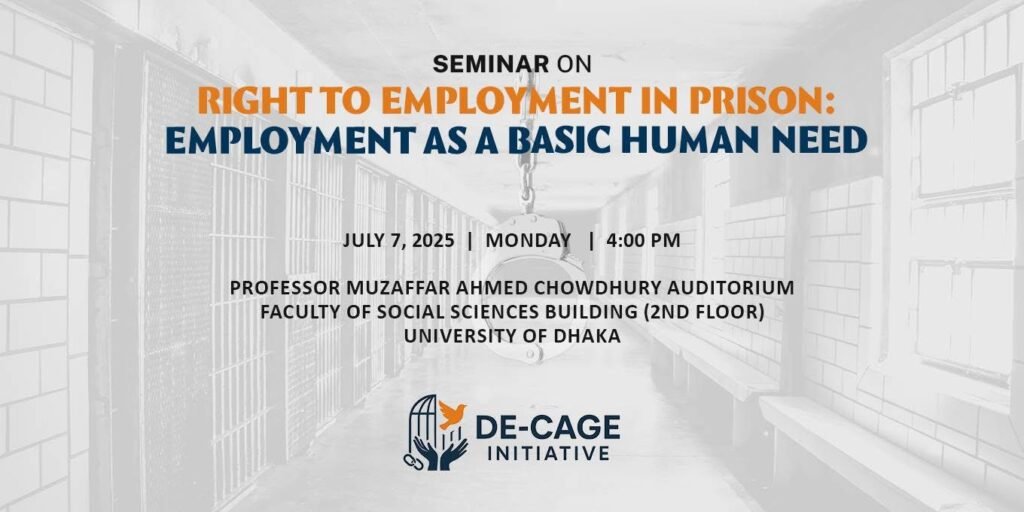
De-Cage Initiative arranged a seminar titled “Right to Employment in Prison: Employment as a Basic Human Need” at the Muzaffar Ahmed Chowdhury Auditorium of the University of Dhaka on July 7, 2025, at 4 pm. The keynote speaker of the seminar was Brigadier General Syed Md. Motaher Hossain, Inspector General of Bangladesh Jail. Other speakers included Md. Forkan Wahid, Jail Super of Narayanganj District Jail; Didarul Bhuiyan, Finance Coordinator of the Rastro Songskar Andolon; Khandaker Raquib, PhD researcher at the University of California; Mohammad Jamil Khan, Head of the Crime Desk of The Daily Star; and Md. Zahirul Islam, Supreme Court lawyer.
In his speech, the keynote speaker highlighted the current scenario of prison employment in Bangladesh’s prisons and the plans of the prison authorities. He said that imprisonment as a punitive measure cannot play any role in the character development of prisoners. If the system of imprisonment is based on rehabilitation, it will increase the character development of the prisoners and their chances of not getting involved in crime again. In this regard, he said that the employment of prisoners in prisons can be an important step. He said that the total number of prisoners in Bangladesh’s prisons is currently about 75000. Out of these, 5000 are elderly people. Of the rest, only 8 percent of the prisoners are involved in productive work in prisons.
As a challenge to prison employment, he said that the current conviction system is very flawed. The rate of conviction of crimes in this system is very low. As a result, 75 percent of the prisoners in prison are undertrials. Only 25 percent are convicted prisoners. Although the current prison code of Bangladesh has a training system for undertrials, there is no provision for making them work in prisons, he said. He also said that about 800,000 people go to prison every year for various reasons. If we consider their families, it can be seen that about 500,000 people are affected by the prison system of Bangladesh in one way or another. 80 percent of the prisoners are the sole earners of their families. As a result, their families face various threats if they are imprisoned without income.
However, the Inspector General of Prisons said that currently 39 types of livelihood programs are being operated in 38 prisons of the country. More than one lakh prisoners have been brought under training under this program. In this training program, the prison authorities are working together with various domestic and international NGOs and various government ministries and organizations (Department of Social Services, Islamic Foundation, etc.). The Inspector General of Prisons said that the Natore District Jail is the most productive among the prisons of the country. He said that the demand for the products produced in the prison is also quite good. However, prisoners are generally not interested in working in prisons with a wage of only 2 taka per day. He said that an increase in wages is essential to advance the prison employment initiative.
The keynote speaker also said that the laws on which Bangladeshi prisons are run are outdated and ineffective in the context of the current era. To adapt to the current situation, the Bangladesh prison authorities have proposed to the government to change the name of the prison to Correction Service, and the government has accepted the proposal in principle, he said. Along with this, he also talked about the introduction of the open jail concept in Bangladesh, following the example of Malaysia and Singapore, where the freedom of movement of prisoners is limited, but other fundamental rights will remain intact. Also, the wages of prisoners will be equal to the prevailing wages in the labor market. However, he also said that no one will be forced to work in that prison. The prison authorities have proposed to establish the Correctional Industrial Park in Bangladesh (CIPB), capitalizing on the concept of open prisons. Initially, there is a plan to include 10,000 prisoners in this initiative. The government has accepted this proposal in principle. He also said that since the old laws are inadequate in the context of the current era, a draft of a law called the Correction Services Act, 2025, is almost ready.
In addition, the prison authorities are considering taking new steps in consultation with the BGMEA to ensure that prison returnees do not face harassment and loss of livelihood when they return to society. A documentary titled Dos and Don’ts is being made so that inexperienced, young prisoners can learn about what to do when they arrive at a prison for the first time. In addition, a documentary is being made so that relatives of prisoners do not become victims of any corruption or harassment. Initiatives are also being taken to launch a call service for prisoners in prison.
Among other speakers, researcher Khandaker Raquib shared his experience with the current prison conditions in Bangladesh. He said that the current prisons are focused on social humiliation. There is no regard for the human dignity of prisoners here. Regarding prison employment, he said that there are some infrastructural limitations in Bangladesh’s prisons. We need to think about employment for prisoners by addressing these issues.
Mr. Didarul Bhuiyan, Finance Coordinator of the Rastro Songskar Andolon, said, “The most obvious form of what a country is like is seen by looking at its prisons.” He shared his experience of living in three prisons – Keraniganj, Kashimpur, and Bogra – for 8 months with the audience. He said sadly that prisons are almost extinct in many countries of the world, and we are proud of having built the largest prison in South Asia. Moreover, since there is a lack of employment outside the prisons in Bangladesh, more thought needs to be taken in creating employment inside the prisons. He also mentioned an organization called ‘Jailtuto Bhai’, which is mainly made up of former prisoners.
Jail Super of Narayanganj District Jail, Md. Forkan Wahid said that if society is not good, the prisons will not be good either. He also called for a change in the negative attitude prevalent in society towards prisons. He said that employment inside the prisons is a human right of prisoners, but he emphasized selecting timely and effective work in the training of prisoners.
The Daily Star’s Crime Desk Head Mohammad Jamil Khan spoke about prison overcrowding. He said that prison overcrowding is largely responsible for all the incidents of jail-breaking that took place in different parts of the country during the 2024 mass uprising. Following him, a Supreme Court lawyer, Zahirul Islam, said that the judicial system of Bangladesh is so flawed that the prison system should not be criticized separately. As long as there are no adequate legal reforms, the situation will improve if lawyers come forward to employ prisoners, he said. He added that the right to employment of prisoners can be limited if necessary; however, it should not be abolished in any way.
The rationale for prison employment in Bangladesh is therefore both economic and social. It creates a productive correctional environment, supports rehabilitation, and enables the prison system to contribute to national output. With proper safeguards, this model can uphold inmates’ dignity, ensure fair labor practices, and serve as a key pillar in modernizing Bangladesh’s correctional infrastructure. The successful implementation of a prison employment program in Bangladesh necessitates the collaboration of key stakeholders, including the Ministry of Home Affairs, Ministry of Social Welfare, Ministry of Industries, Department of Prisons, NGOs engaged in legal aid and rehabilitation, private sector partners from the garments as well as international development organizations offering technical and financial support.
Bangladesh stands at a turning point. We have the legal basis, the social need, and the international guidance to reform our prisons not as warehouses of despair, but as institutions of opportunity and transformation. A rights-based prison industry offers a concrete, lawful, and humane way forward. It is time to reimagine incarceration, not as a punishment in isolation, but as a platform for dignity, rehabilitation, and social development.