
Death penalty is one of the harshest forms of punishments that are legal and actively used in Bangladesh. Under the Penal Code, death penalty may be imposed for offences such as murder (Section 302), dacoity with murder (Section 396), waging war against the State (Section 121), and abetting the suicide of a child or mentally disabled person (Section 305). Beyond the Penal Code, various special laws also prescribe the death sentence. These include the Women and Children Repression Prevention Act 2000 for offences like rape causing death and killing following trafficking; the Narcotics Control Act 2018 for large-scale drug trafficking and possession above statutory thresholds; and the Anti-Terrorism Act 2009, which allows the death penalty for terrorist acts resulting in death. Additionally, crimes such as genocide and crimes against humanity under the International Crimes (Tribunals) Act 1973, and deaths caused through explosives or human trafficking, may also attract capital punishment. Overall, Bangladesh maintains one of the widest ranges of death-eligible offences in South Asia.
However, although death penalty has popular approval in Bangladesh, human rights activists referred to the misuse and overuse of death penalty on several occasions. Critics have problematized the arbitrary and illegitimate use of death penalty in the criminal justice process. A recent PBI study revealed that 52% of murder trials in Bangladesh resulted in acquittals, illustrating systemic dysfunction in the justice system. Analyzing 238 cases from 1986 to 2015 showed chronic issues in investigation and prosecution, including out-of-court settlements, inconsistent evidence, and excessive judicial delays sometimes extending up to 18 years. On average, cases that ended in conviction took around 1 year and 2 months for investigation and 10 years and 3 months for trial, while acquitted cases took even longer. This inefficiency undermines public trust and perpetuates impunity. The PBI recommended creating an independent investigation agency to ensure impartiality, highlighting the need for reform in Bangladesh’s justice system.
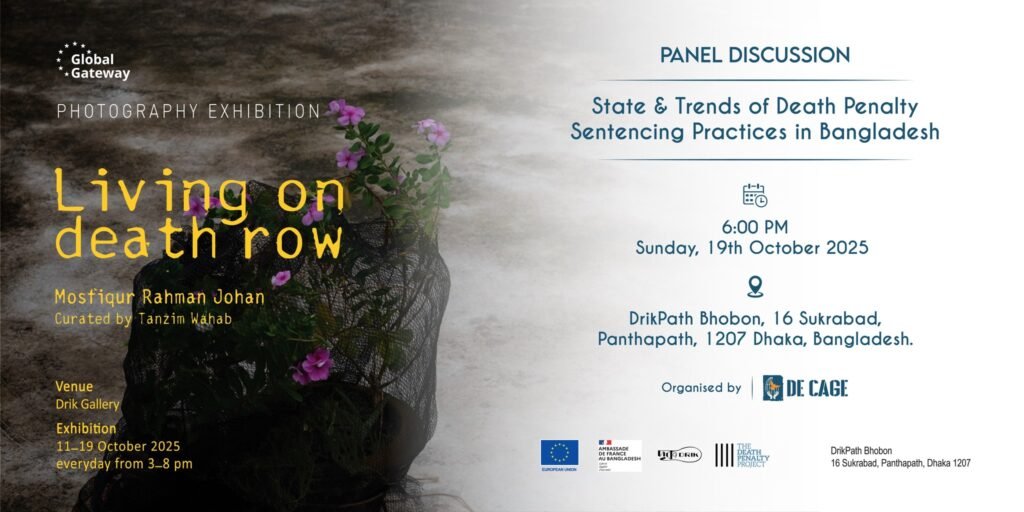
A panel discussion titled “State & Trends of Death Penalty Sentencing Practices in Bangladesh” was held on October 19, 2025 at 6 p.m. at Drik Gallery in Drik Bhavan, Panthapath, Dhaka. The event was organized by the Dhaka-based research organization Decage, as part of an art exhibition titled “Living on Death Row.”
The discussants at the panel included Shafiqul Alam, Press Secretary to the Chief Adviser of the Interim Government and a veteran journalist; Advocate Mohammad Shishir Monir, a prominent lawyer of the Supreme Court; Barrister Mushfiqul Huda, another lawyer of the Supreme Court; and Shah Newaz Sakib, Executive Director of Decage.
In his speech, Advocate Shishir Monir stated that every stage of Bangladesh’s criminal justice system requires highly skilled and sophisticated personnel, which is currently lacking. He pointed out that the process of collecting evidence in Bangladesh is extremely flawed. Due to the absence of proper and modernized investigation systems, it often becomes impossible to accurately identify offenders. Therefore, he emphasized the urgent need to establish a permanent investigation agency in the country to ensure justice in murder cases. He further mentioned that under the current conditions of intense media trials and social pressure, judges in the lower courts often lack the mental maturity and impartiality required to handle death penalty cases fairly. As a result, about 60 percent of death sentences issued by lower courts are overturned by the High Court, and a significant portion of the remaining cases are reversed by the Appellate Division as well. He added that there are currently around 2,156 death-row prisoners in Bangladesh. Given the faulty offender identification system, he suggested that the implementation of death sentences should be suspended through a moratorium. He also called for ending the practice of sending convicts to condemned cells immediately after sentencing, noting that a related case is currently under judicial review. Referring to developments in India, he noted that changes in the law there now make audio-visual recording of confessional statements mandatory, which has significantly reduced the culture of torture-based and forced confessions in India. He suggested that Bangladesh’s laws should also be reformed similarly. He further emphasized the importance of the proper implementation of the Right to Information Act to make death penalty–related data publicly accessible.
In his remarks, Barrister Mushfiqul Huda said that independent and specialized homicide units should be established in every district of Bangladesh to investigate murder cases. Referring to the colonial-era practice of using confessional statements, which he described as the “culprit of the law,” he recalled that the trial of revolutionary Khudiram Bose was the first case in the Indian subcontinent where a death sentence was issued solely based on a confession. Unfortunately, he said, this colonial provision still remains in force in independent Bangladesh. He further stated that sending a convict to a condemned cell immediately after the verdict is deeply inhumane, as it causes severe mental trauma. In his view, a person should only be sent to a condemned cell after the death sentence is upheld by the Appellate Division.
Shafiqul Alam, Press Secretary to the Chief Adviser, remarked that Bangladeshi society is relatively stable, with 19 to 23 murders per million people, amounting to roughly 4,000 murders annually. Unfortunately, he said, this grim reality has been largely normalized by the public. He observed that the justice system in Bangladesh operates in a toxic environment, where media trials are rampant and enormous public pressure makes it nearly impossible for judges to adjudicate cases calmly and rationally. Calling on journalists and media professionals to act more responsibly, he said that as a nation, “we have not yet reached maturity.” According to him, childish behavior and flawed activism often hinder the pursuit of justice. He also lamented the lack of intellectual parliamentarians in the country, noting that even their choice of words is often problematic. Consequently, Bangladesh has yet to produce a timeless document like a Bill of Rights or the U.S. Constitution. He stressed the need to modernize and humanize the fragile criminal justice system inherited from the British colonial period.
Shah Newaz Sakib, Executive Director of Decage, stated that many impoverished individuals confess under police remand simply because they cannot afford legal assistance or they can not bribe the police. Moreover, those who voluntarily confess do not receive the discount of punishment they are legally entitled to. He added that since the criminal justice system of Bangladesh is largely inefficient, it tends to acquit wealthy and influential offenders while unjustly sentencing innocent poor individuals to death. According to him, this unjust culture can only be changed by modernizing the existing system of confession-taking in Bangladesh.
The state and trends of death penalty sentencing practices in Bangladesh reveal a system marked by both longstanding legal traditions and evolving challenges. While the death penalty remains embedded in the country’s criminal justice framework, recent patterns show increasing scrutiny from human rights bodies, legal experts, and civil society. Issues such as overcrowded death row populations, prolonged trial delays, inconsistent evidentiary standards, and the risk of wrongful convictions continue to shape the national discourse. At the same time, global shifts toward abolition and regional legal reforms are influencing public debate and policy considerations.
As Bangladesh reflects on its commitment to justice, fairness, and human dignity, it becomes crucial to reassess how capital punishment aligns with constitutional guarantees and international human rights norms. Ultimately, understanding these trends is not only about evaluating legal practices but also about fostering a justice system that prioritises accountability, transparency, and the protection of fundamental rights for all.